The Best Engineer You Can't Hire
An agent-enabled engineer can ship a production site in under a day. But that person costs $200k+ and takes months to hire. Or you can just use a9s.
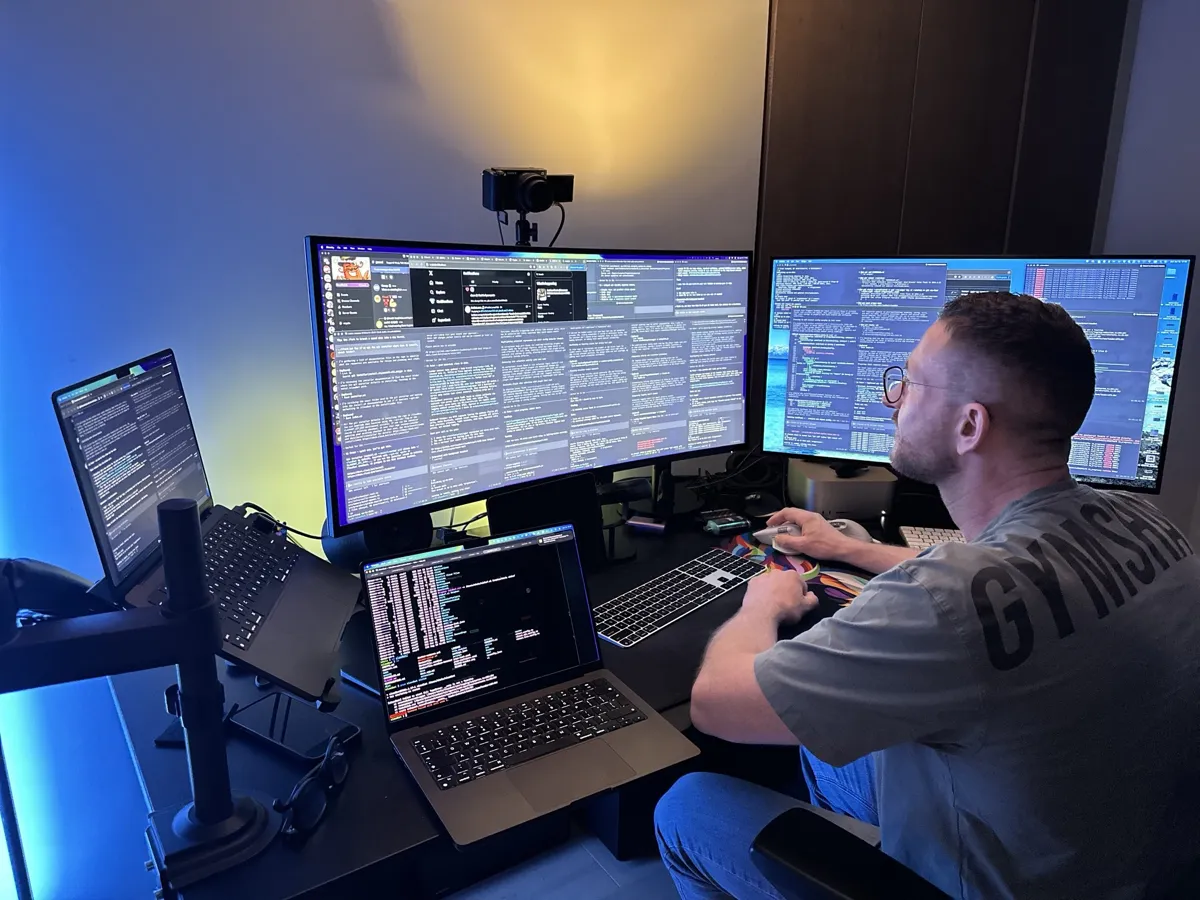
Last month, Peter Steinberger — creator of OpenClaw — posted a photo of his desk setup. Multiple monitors, each running autonomous coding agents in parallel. His GitHub contribution graph looked inhuman: thousands of contributions per day across dozens of repos. One person producing the output of an entire engineering team.
Weeks later, OpenAI acquihired him. Sam Altman personally announced it, calling him "a genius with amazing ideas about the future of agents." The rumored price: millions.
Steinberger is the prototype of a new kind of engineer. Someone who doesn't just write code — they direct fleets of AI agents that write code for them. They think in systems, spec in detail, and review at speed. One of these engineers can produce the output of a small team.
The problem? You can't hire them. OpenAI already did.
The supply problem
The engineers who are truly effective with AI agents — not just using coding assistants for suggestions, but orchestrating fully autonomous agents across complex codebases — are rare. They need deep engineering experience to know what "good" looks like, plus the skill to direct AI effectively. That combination barely exists in the talent market yet.
The few who have figured it out are either getting acquihired by frontier labs, founding their own companies, or freelancing at premium rates. They cost $200k+ a year — if you can even find them. They take months to recruit. Weeks to ramp on your codebase. And they can only work on one project at a time.
Meanwhile, your backlog grows.
We put this to the test
We needed a marketing site for a9s.dev. Rather than hiring an agency or using an AI app builder, I decided to model it like a real customer engagement. I knew roughly what we wanted: a landing page that communicates our positioning, interactive elements that show the product in action, an estimator for instant scoping, a blog, analytics, and proper CI/CD infrastructure.
I fed those requirements into an agent to do research and produce a detailed spec — information architecture, target audience, messaging guidelines, section-by-section copy direction. This is the same kind of input any customer would give us: a description of what needs to ship and why.
From there, I set a9s agents to work building the site. The first draft came back spot-on to the spec and properly scaffolded:
- 12 pages with SEO-optimized metadata
- 20+ custom React components with interactive animations
- Multi-step cost estimator with agency price comparison
- Embedded scheduling, analytics, and blog infrastructure
- Terraform-managed Cloudflare Pages, DNS, and CI/CD
Everything worked and matched the spec. But it wasn't something I'd be proud to hand off to a client yet. The design was competent but generic. The copy hit every point but lacked voice. The animations functioned but didn't feel polished. This is where AI app builders stop — and where most people conclude that "AI can't build good products."
The last 10%
Luckily we had the human lead — me — to guide the final layer of polish. I pushed the agents toward a distinctive terminal-inspired brand instead of a generic dark theme. Rewrote the headlines until "Stop hiring. Start shipping." clicked. Iterated on the CRT monitor animation until the perspective looked right. Made technical calls like migrating to Next.js for future flexibility and setting up Terraform instead of manual deploys.
The agents gave me an excellent foundation — everything was architecturally sound, fully functional, and spec-compliant. The final manual polish is what transformed it from "solid AI output" into something with real personality and craft. That last 10% requires taste, experience, and judgment — exactly what a senior engineer brings.
The result is the site you're reading right now. I'm happy with it. But I'm most happy that it took under a day and I didn't have to pay $20-40k to a traditional agency or spend 4-6 weeks waiting for deliverables.
Design is the hardest case
I'll be honest: this was a design-heavy project, which is the hardest category of work for AI agents right now. Design is subjective — agents can implement any visual direction, but they can't judge whether it looks good. Font pairing, spacing rhythm, animation timing, knowing when something has "too much flair" — that still requires a human eye.
For backend work — API integrations, migrations, test coverage — agents operate with much higher autonomy because the success criteria are deterministic. Tests pass or they don't. The API responds correctly or it doesn't. There's less need for the human to guide taste.
The fact that we could deliver a polished, distinctive, design-heavy site in under a day — even in the hardest case — says a lot about what's possible for the more objective engineering work that fills most backlogs.
The real insight
The best results in software right now come from experienced engineers who know how to leverage AI agents. But that talent is scarce, expensive, and slow to hire. The Steinbergers of the world are getting snapped up by frontier labs for millions.
a9s is what happens when you take that exact capability — senior engineer + cutting-edge AI tooling — and offer it as a service. You get the quality without the headcount. The speed without the recruiting cycle. The cutting edge without the $200k salary.
You don't need to hire the best engineer you can't find. You just need to call us.
Ready to see what this looks like for your backlog? Book a 15-minute demo.